
Introduction: In the digital era, programming has emerged as a powerful force shaping our future. Once a niche field, coding has become a universal language, influencing everything from our daily devices to global industries. This article explores the profound impact of programming on our lives and the pivotal role it plays in defining the next decade of innovation.
Embracing the Universal Language: Programming has evolved into a fundamental skill, akin to learning a language. It has become so ingrained in our lives that we often code without realizing it. From automating mundane tasks to enabling seamless collaboration, coding has become a digital assistant, enhancing efficiency across all sectors.
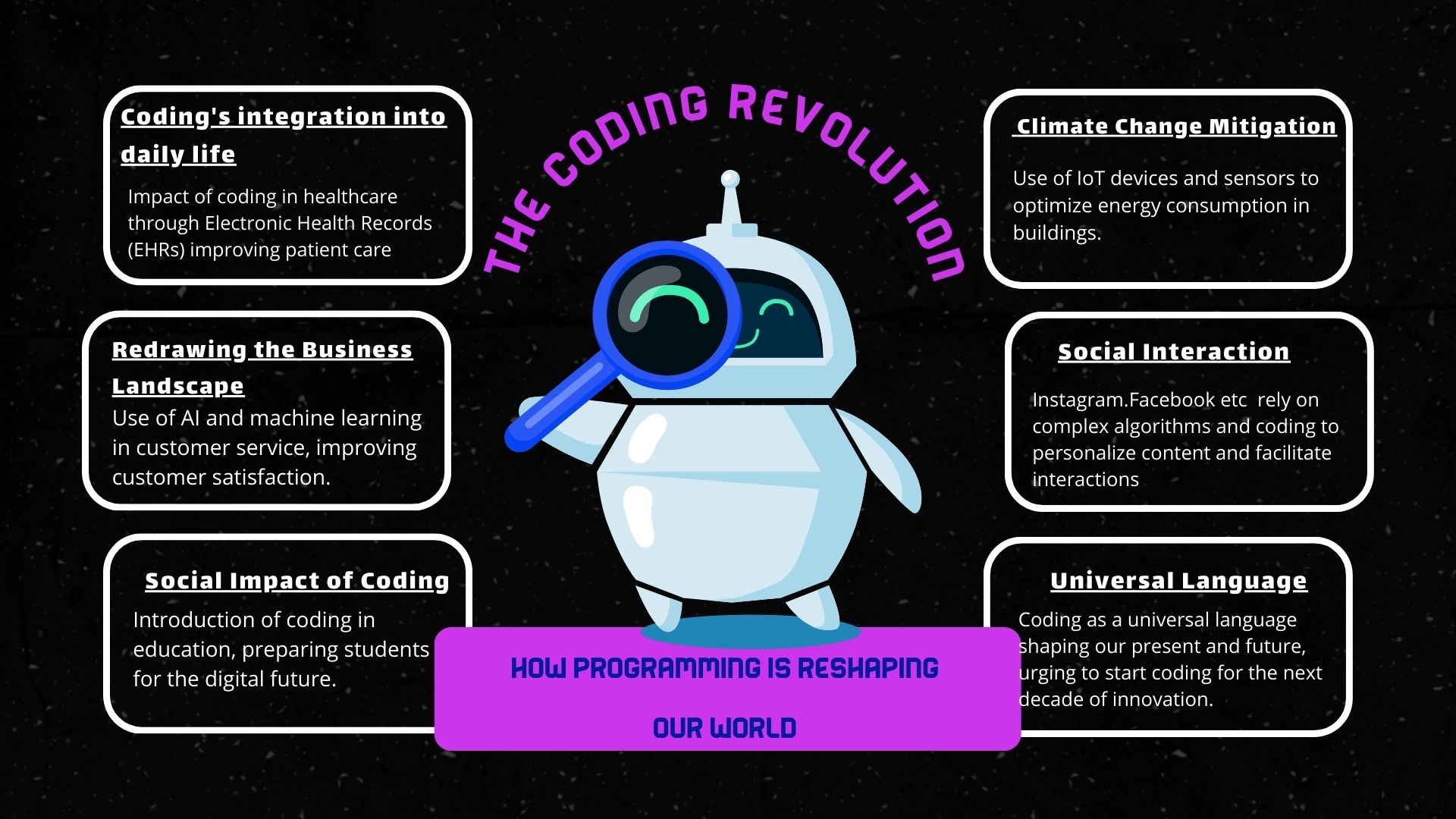
For example, consider the impact of coding in the healthcare sector. Electronic health records (EHRs) have revolutionized patient care by allowing healthcare professionals to access patient information quickly and securely. This has led to improved patient outcomes and more efficient healthcare delivery.
Redrawing the Business Landscape: Coding is redefining how businesses operate, enhancing efficiency, driving innovation, and strengthening security. Automation, powered by coding, is revolutionizing traditional work environments, allowing teams to focus on strategic tasks and fostering a culture of innovation.
One such example is the use of artificial intelligence (AI) and machine learning in customer service. Companies are using chatbots and virtual assistants to provide immediate customer support, reducing the need for human intervention and improving customer satisfaction.
Beyond Business: The Transformative Impact of Coding in Education, Healthcare, and Social Interaction
Education: Coding is revolutionizing education by equipping students with essential digital skills. In many schools, coding has become a core part of the curriculum, teaching students how to think logically, solve problems, and collaborate effectively. For example, in the United Kingdom, coding is now a mandatory subject in primary and secondary schools. Students learn to code through interactive activities and projects, preparing them for careers in technology and beyond.
Moreover, coding has made learning more engaging and interactive. Educational apps and platforms use gamification and interactive simulations to teach complex concepts in a fun and accessible way. For example, platforms like Scratch and Code.org allow students to create their own games, animations, and interactive stories, making learning to code a creative and enjoyable experience.
Healthcare: In healthcare, coding is transforming how services are delivered and improving patient outcomes. Electronic Health Records (EHRs) have streamlined the management of patient information, making it easier for healthcare providers to access and share data. This has led to more coordinated and efficient care, reducing medical errors and improving patient safety.
Moreover, coding is driving innovation in healthcare technology. Telemedicine, for example, allows patients to consult with healthcare providers remotely, reducing the need for in-person visits and improving access to care, especially in rural or underserved areas. Wearable devices and mobile apps are also using coding to monitor patients’ health in real-time, providing valuable data for healthcare professionals to make informed decisions.

Social Interaction: Coding is reshaping how we communicate and connect with each other. Social media platforms like Facebook, Twitter, and Instagram rely on complex algorithms and coding to personalize content and facilitate interactions. These platforms have transformed how we share information, stay connected with friends and family, and engage with the world around us.
Moreover, coding is powering the development of virtual reality (VR) and augmented reality (AR) technologies, creating immersive and interactive experiences. These technologies are being used in fields like education, entertainment, and healthcare, allowing users to experience virtual environments and interact with digital content in new and exciting ways.
The Role of Programming in Climate Change Mitigation: Programming is also playing a crucial role in combating climate change. Through data analysis, predictive modeling, and real-time monitoring, programmers are developing solutions to optimize energy consumption, monitor pollution levels, and predict climate trends, contributing to a sustainable future.
For example, companies are using IoT devices and sensors to collect data on energy usage in buildings. This data is then analyzed using machine learning algorithms to identify areas where energy can be saved, leading to a more efficient use of resources and a reduction in carbon emissions.
Navigating the Coding Wave: A Practical Guide: To embark on the coding journey, start by learning a programming language, practicing regularly, working on real projects, and staying updated with the latest trends. By following this roadmap, you can harness the power of coding to drive innovation and shape the future.
How to Start Coding: The Ultimate Guide for Beginner Programmers (codemagnet.in): The Coding Revolution: How Programming is Reshaping Our WorldConclusion: Programming is no longer just a skill for the tech-savvy—it is a universal language that is shaping our present and future. By embracing coding, we are not only coding our computers but also coding our future. The possibilities are endless, and the time to start coding the next decade of innovation is now.
Wish to Learn coding and become a web developer?Learn about our course which we provide for free below
HTML, CSS & JavaScript For Beginners (codemagnet.in): The Coding Revolution: How Programming is Reshaping Our World




Leave a Reply