
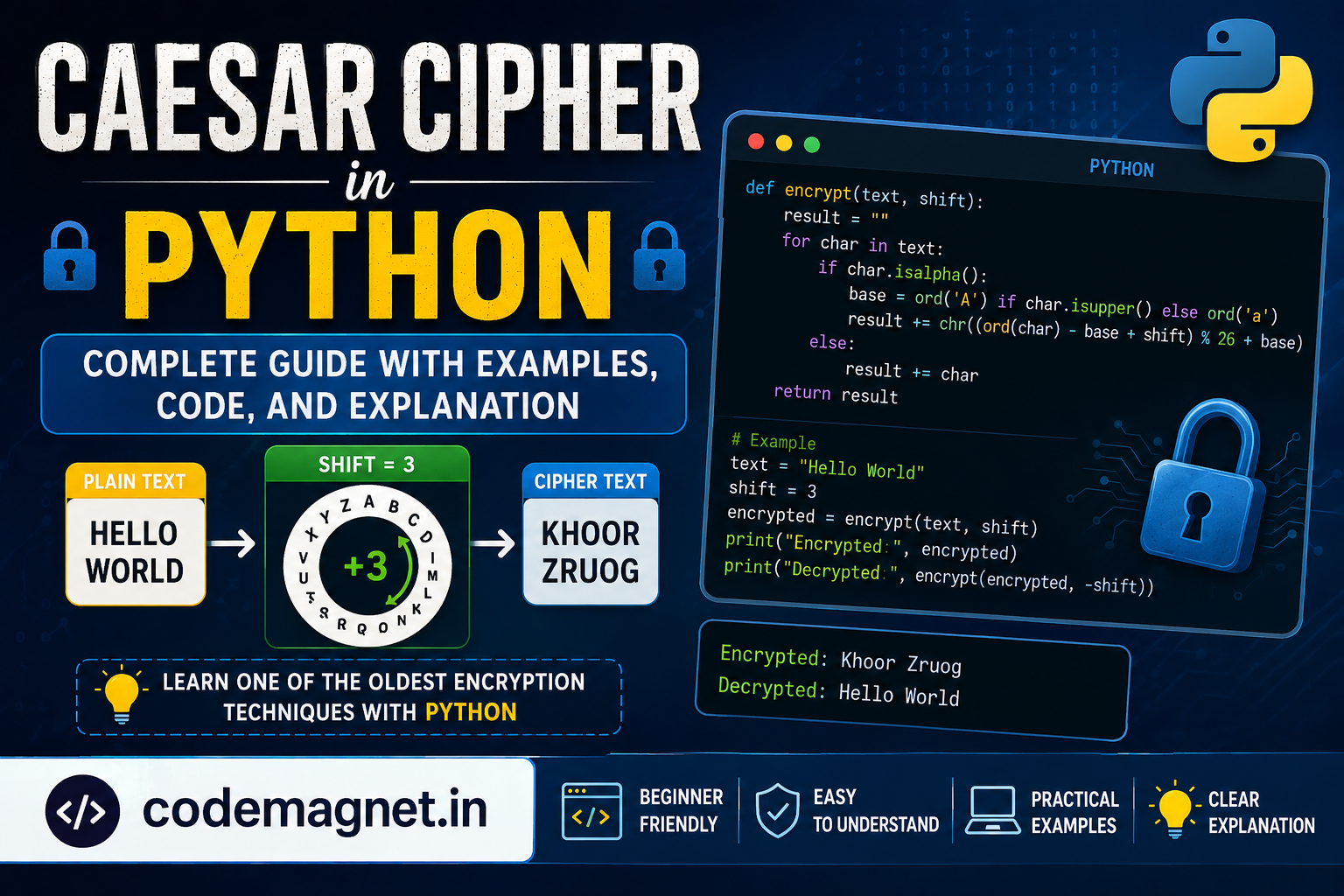
Caesar Cipher in Python –
In today’s digital world, where data security is more important than ever, understanding the basics of encryption is a valuable skill for any developer. While modern cryptography uses highly advanced algorithms, every journey begins with simple concepts—and one of the most famous starting points is the Caesar Cipher.
The Caesar Cipher is one of the oldest encryption techniques in history. Despite its simplicity, it provides a strong foundation for understanding how encryption and decryption work. When combined with Python, it becomes an excellent hands-on learning exercise for beginners and intermediate programmers alike.
In this complete guide, you will learn:
What Caesar Cipher is
How it works step-by-step
How to implement it in Python
Advanced coding techniques
Real-world insights and limitations
Let’s dive in.
What is Caesar Cipher?
The Caesar Cipher is a type of substitution cipher where each letter in a message is shifted by a fixed number of positions in the alphabet.
It was named after Julius Caesar, who used it to send secret military messages.
Example
If the shift value is 3:
| Original | Encrypted |
|---|---|
| A | D |
| B | E |
| C | F |
So the word:
HELLO → KHOOR
Each letter is shifted forward by 3 positions.
How Caesar Cipher Works
The logic behind Caesar Cipher is straightforward:
- Choose a shift value (also called a key)
- Replace each letter with another letter shifted forward
- Wrap around if the end of the alphabet is reached
Wrap-around Example
- Z + 1 → A
- Y + 3 → B
This wrap-around behavior is what makes the cipher continuous.
Wrap-around Example
- Z + 1 → A
- Y + 3 → B
This wrap-around behavior is what makes the cipher continuous.
Encryption Formula:
E(x)=(x+n)mod26
Decryption Formula:
D(x)=(x−n)mod26
Where:
x= position of the letter (0–25)n= shift value% 26ensures values stay within alphabet range
Why Use Python for Caesar Cipher?
Python is one of the best languages for implementing this cipher because:
- Simple syntax
- Powerful string handling
- Built-in functions like
ord()andchr() - Easy to read and debug
This makes it perfect for beginners learning encryption concepts.
Basic Caesar Cipher Implementation in Python
Let’s start with a simple encryption function.
def encrypt(text, shift): result = "" for char in text: if char.isalpha(): base = ord('A') if char.isupper() else ord('a') result += chr((ord(char) - base + shift) % 26 + base) else: result += char return resultprint(encrypt("Hello World", 3))

Explanation
ord(char)→ Converts character to ASCIIchr()→ Converts ASCII back to character% 26→ Ensures wrap-aroundisalpha()→ Checks if character is a letter
Decryption in Python
Decryption is simply reversing the shift:
def decrypt(text, shift): return encrypt(text, -shift)print(decrypt("Khoor Zruog", 3))
Full Program with User Input
def caesar_cipher(): text = input("Enter message: ") shift = int(input("Enter shift value: ")) mode = input("Encrypt or Decrypt (e/d): ").lower() if mode == 'e': print("Encrypted:", encrypt(text, shift)) elif mode == 'd': print("Decrypted:", decrypt(text, shift)) else: print("Invalid choice")caesar_cipher()
Handling Edge Cases
A robust implementation should handle:
- ✔ Uppercase & lowercase letters
- ✔ Spaces and punctuation
- ✔ Negative shifts
- ✔ Large shift values (e.g., 52 = no change)
Advanced Caesar Cipher Using OOP
class CaesarCipher: def __init__(self, shift): self.shift = shift % 26 def encrypt(self, text): return self._process(text, self.shift) def decrypt(self, text): return self._process(text, -self.shift) def _process(self, text, shift): result = "" for char in text: if char.isalpha(): base = ord('A') if char.isupper() else ord('a') result += chr((ord(char) - base + shift) % 26 + base) else: result += char return result
Example Usage
cipher = CaesarCipher(5)encrypted = cipher.encrypt("Python Programming")print("Encrypted:", encrypted)decrypted = cipher.decrypt(encrypted)print("Decrypted:", decrypted)
Brute Force Attack
Since there are only 26 possible shifts, Caesar Cipher is easy to crack.
def brute_force(text): for shift in range(26): print(f"Shift {shift}: {decrypt(text, shift)}")brute_force("Khoor Zruog")
Limitations of Caesar Cipher
Despite its usefulness in learning, Caesar Cipher is not secure.
Major weaknesses:
- ❌ Only 26 keys
- ❌ Easily breakable
- ❌ Vulnerable to frequency analysis
- ❌ Not suitable for real-world encryption
Real-World Learning Applications
Even though it’s outdated, it’s still valuable for:
- Learning cryptography basics
- Understanding encryption logic
- Practicing Python coding
- Teaching algorithm design
Variations of Caesar Cipher
🔹 ROT13
- Fixed shift of 13
🔹 Extended Cipher
- Includes symbols and numbers
🔹 Custom Shift Patterns
- Multiple shifting strategies
Developer Tips
- Use modular code
- Add comments
- Handle edge cases
- Keep logic simple
- Test with different inputs
The Caesar Cipher may be simple, but it plays a powerful role in helping developers understand the fundamentals of encryption. It demonstrates how data can be transformed, secured, and later restored using a defined key.
While it’s not suitable for modern security systems, it remains one of the best starting points for learning cryptography. And with Python, implementing it becomes both easy and enjoyable.
If you’re serious about learning encryption, this is where your journey begins.





Leave a Reply